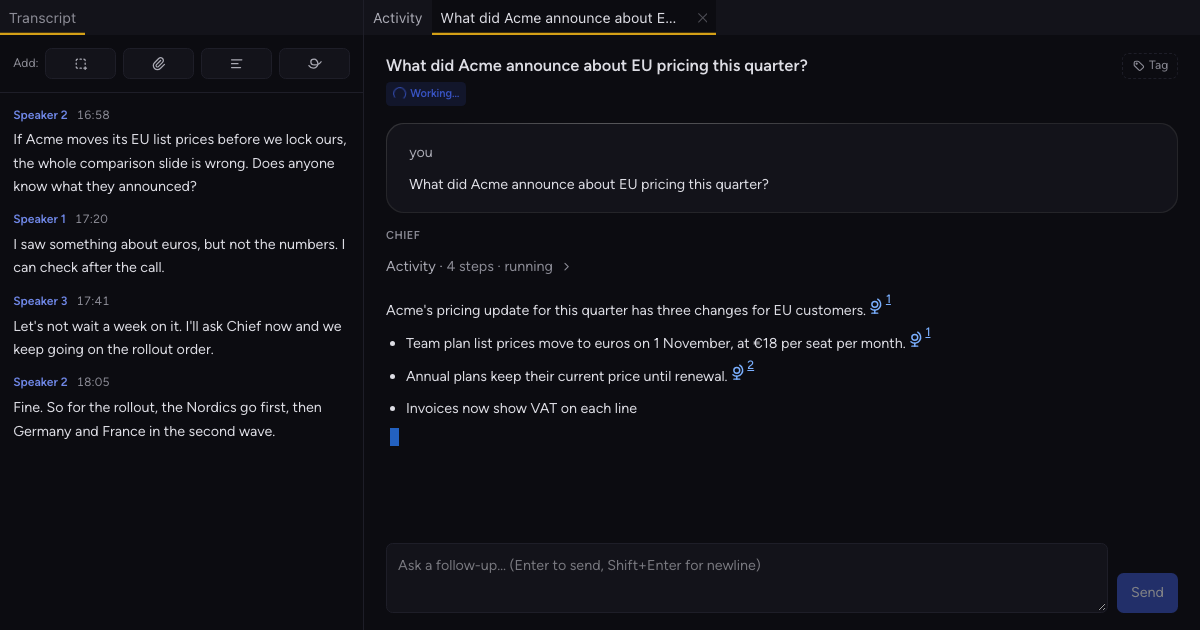
What does a chief of staff do? A chief of staff manages a leader's time, information and decisions, preparing them for meetings and following up until each decision becomes owned work. The carrying and the record-keeping are logistics a system can hold for a whole team; the judgement, trust and authority that make the role work still need a person.
Our product, Chief, captures meetings and turns them into work, which gives us an interest in the second half of that answer.
Key Takeaways
- A chief of staff makes a leader's time, information and decisions work: prep before meetings, context between them, follow-up after.
- Demand is rising: Indeed counts chief-of-staff postings up 85% since early 2020, and Live Data Technologies counts three times as many North American title holders as in 2021.
- One half of the job is logistics, and that half is what people are building "AI chief of staff" tools for.
- The other half (judgement, trust, speaking with the leader's authority) still needs a person.
- A team can share the record-keeping when the meeting record, its decisions and its to-dos live in one project everyone can open.
What does a chief of staff do day to day?#
A chief of staff runs the system around a leader so the leader spends attention on the decisions only they can make. Dan Ciampa, writing in Harvard Business Review in May-June 2020, describes what that system does.
That system "ensures that leaders make the most of their limited time." It also makes sure "that information arrives at the right point in their decision-making process, and that follow-up happens without their having to check."
In practice, the work comes back to the same few duties, each one named in Ciampa's examples:
- Prep before meetings. One chief of staff in the article "prepares prework."
- A seat in the room. That chief of staff also "sits in on most board meetings."
- Follow-up after. The same chief of staff "handles follow-up," and follow-up is what turns a decision into someone's job.
- Time and information. At the top level, the job "includes time management, flow of information to and from the CEO."
- Connecting the work. Another chief of staff in the article describes the role as an "integrator connecting work streams that would otherwise remain siloed."
The same top-level job includes "seeing that the CEO is always prepared and rarely surprised." That phrase explains why the role is hard to describe from a job posting. The leader never sees most of the work when it goes well.
Chief of staff vs executive assistant vs COO#
Some people think of the role as "an executive assistant job on steroids," as Korn Ferry put it on 2026-07-22. Clara Ma, quoted in the New York Times on 2026-08-06 and excerpted by TaxProf on 2026-08-09, draws the line differently.
An executive assistant "figures out what time something goes on the calendar, but a chief of staff figures out whether it should go on the calendar at all."
Side by side, the three roles split like this:
- An executive assistant works out when something goes on the leader's calendar.
- A chief of staff works out whether it belongs there at all, and works through influence, often with no direct reports.
- A COO runs the organization's operations and usually has direct reports.
Whether something belongs on the calendar is a judgement call, and the job splits in two along it.
Why are so many CEOs hiring one now?#
The same Korn Ferry piece calls the role "in vogue again," and three separate data sets agree on the direction.
Indeed counts chief-of-staff postings up 85% since early 2020, as the New York Times reported on 2026-08-06. Revelio Labs found that postings more than doubled year over year, according to Bloomberg, syndicated by Carrier Management on 2026-07-16.
The number of people holding the title has grown too. Live Data Technologies counts three times as many chiefs of staff in North America as in 2021, a figure Korn Ferry repeated on 2026-07-22.
The pay follows the demand. The New York Times cites a survey putting the role at $150,000 to more than $200,000. Fortune reported on 2026-08-10 that "some positions in technology and finance can reach $400,000 or more."
Leadership changes are one trigger. Research by Zhou at Claremont McKenna, reported by HCAmag on 2026-08-18, found that nearly half of respondents said the role was created or strengthened after a CEO change. A new leader inherits a company's information flow and needs someone to rebuild it around them.
Which parts of the job are logistics, and which are judgement?#
The job splits into two halves:
- Logistics: time, information, prep and follow-up. Software can hold this half.
- Judgement: trust, standing and the leader's authority. This half belongs to one person.
The logistics half. Time, information, prep and follow-up all move things around. One CEO in Ciampa's article felt "more confident delegating (because he knew that his CoS would follow up)." Ciampa's diagnostic for whether a leader needs one is blunt: "do you often not hear back until you remind people?"
All of this is carrying: context to the meeting that needs it, and each decision to its owner.
The judgement half. The rest of the job runs on things no process supplies. The chief of staff carries "the implicit imprimatur of the CEO," in Ciampa's words. A leader new to the company "will require even more from a CoS," he writes, including "emotional intelligence, judgment, discretion, diplomacy, and political acumen." The role acts as "honest broker and truth teller," and it rests on "chemistry and trust."
Craig Stevens of Boyden put the same point to Bloomberg on 2026-07-16: "You're connected to the person more than the position." That connection belongs to two people, and no system can hold it.
The cost of one router. Korn Ferry's David Farris names the model's weakness in the same 2026-07-22 piece. He has "seen chiefs of staff create more, not less, blockage and bottlenecks." When every decision and every update flows through one person, that person becomes the place work waits.
People building an "AI chief of staff" are building the logistics half#
Those builders are right that software can do that work. A GitHub search for "ai chief of staff" in:name,description returned 551 repositories on 2026-10-03, counting all time. You can run the same search yourself.
The descriptions, read on GitHub on 2026-10-03, sell memory and commitments. kbanc85/claudia "Remembers relationships, tracks commitments, helps you think strategically." georgeding/Relate "remembers what they said and what you promised." Both describe carrying, the first half of the job.
On Hacker News, the phrase has also come to mean one agent coordinating others. "Orchestrating Claude Code Agents: The Chief of Staff Pattern" reached 25 points on 2026-09-20. The personal version shows up too. arkmm wrote on HN on 2026-08-09: "Think it'd be cool to have a self hosted AI "chief of staff" that has full read access to my personal info."
Chiefs of staff and senior operators already lean on AI. The Chief of Staff Network's own AI Readiness Diagnostic, published 2026-05-13 with "250+ senior leaders," found 86% use AI daily. Only 12.5% connect it to other tools.
The builders have the logistics right. Memory, commitments and briefs are things software can hold. The limit is ownership. A personal build runs from one person's account, and the rest of the team still has no shared record.
Nadia Okafor, comparing two meeting tools on Medium on 2026-04-24, described that gap after a colleague needed context from an old call. "Those notes lived in my Granola account. They weren't a team resource."
Which part can a tool carry for the whole team?#
The part a team can share is the record: what the group decided, who took what on, and where to find it again. Chief does for the whole team what a chief of staff does for one executive, for that record only.
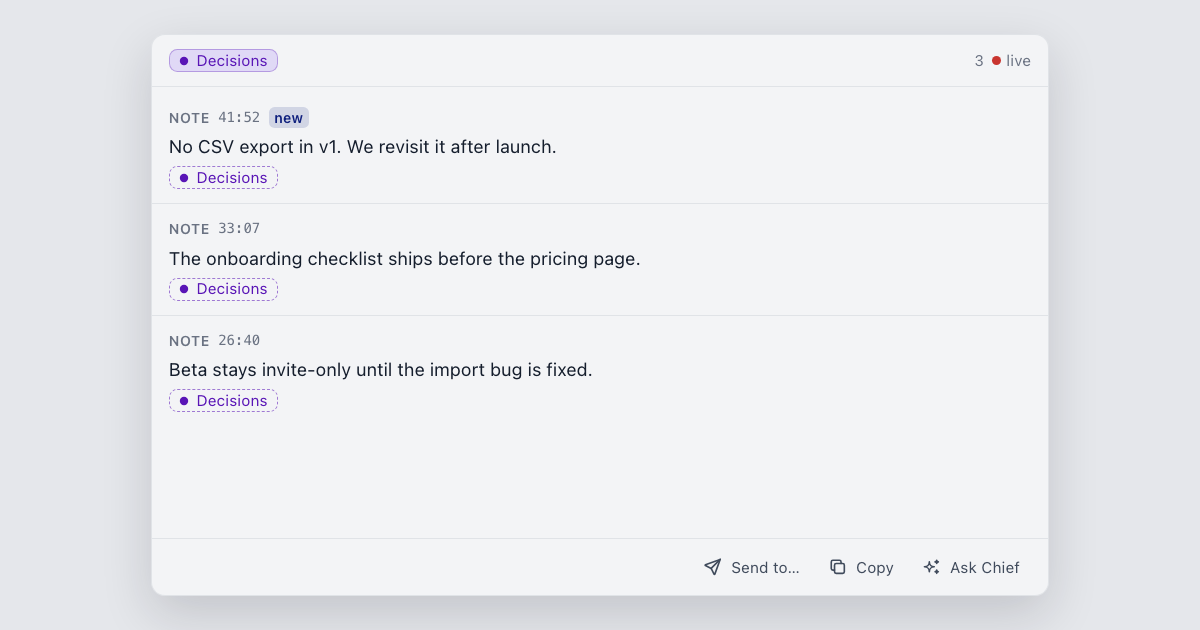
Chief sorts each point it writes, and the Auto-apply Tags land where they fit. Every project starts with two, To-dos and Decisions, and your team can write its own. A point tagged Decisions is something the group settled, not something it floated. A to-do carries the name of whoever took it on, when the call makes that clear.
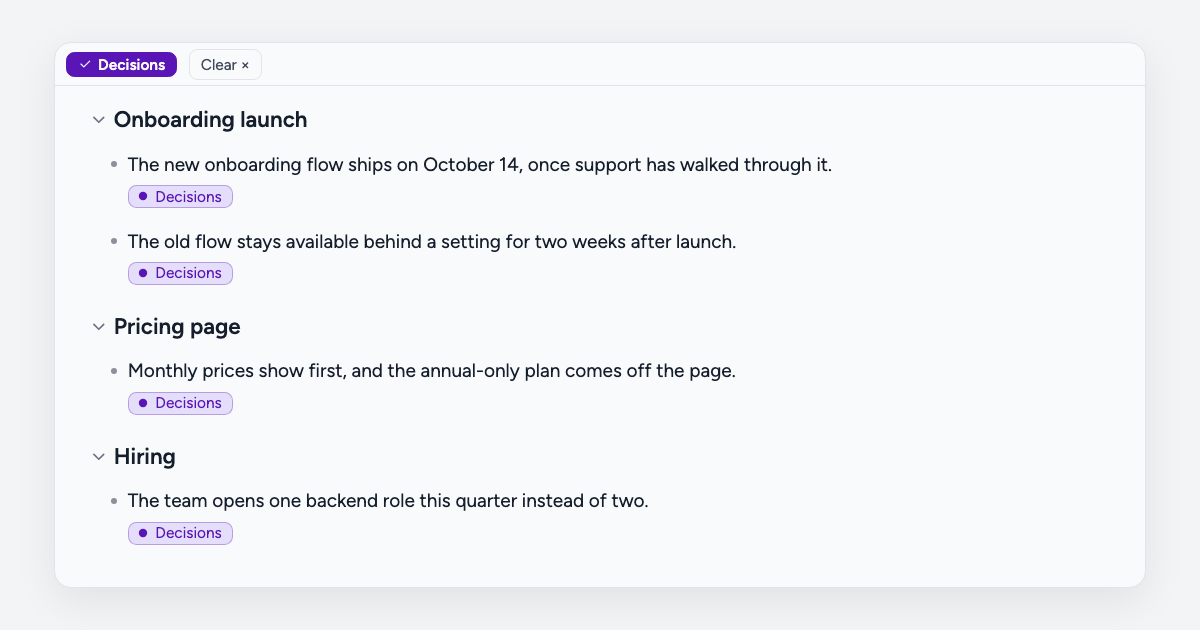
The session stays in its project, and everyone on the project can open it, read-only for readers. The project's Live Sessions list shows each session with the name of the person who ran it. On the web, a teammate opens the session and filters its summary to Decisions. Tags are created and applied in the desktop app.
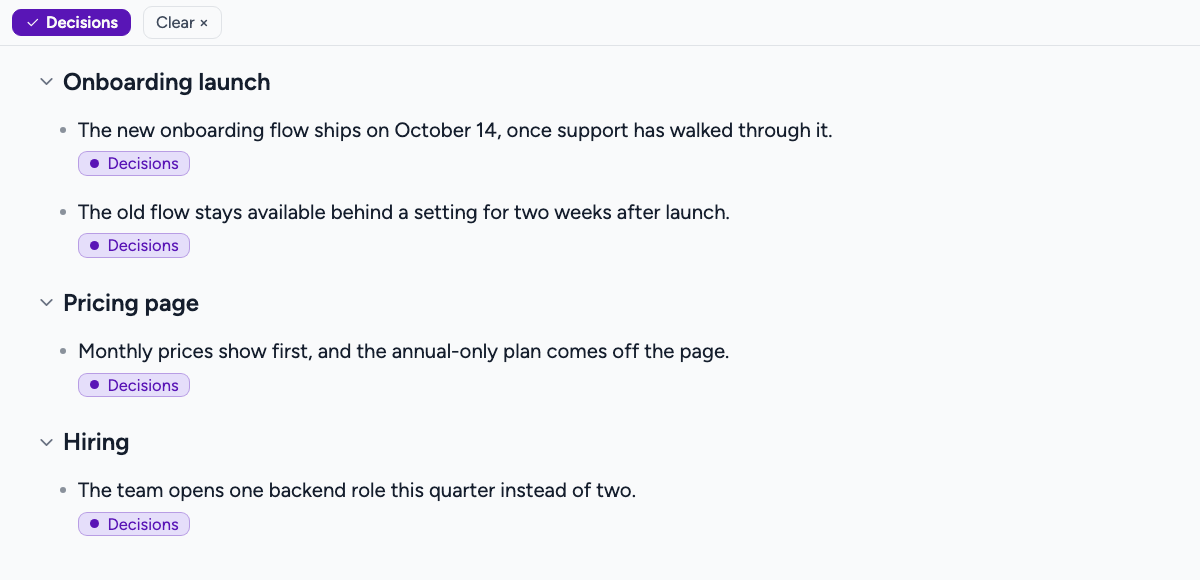
Ask Chief when something was said and you get a link that opens the transcript at that moment. Chief finds a past session by its title and summary, then reads that session's transcript to answer.
The shared record is also an answer to the Farris bottleneck. When the record lives in a project everyone can open, a teammate doesn't have to route through one person to learn what the group decided.
Chief names a to-do's owner only as the call states it, and it doesn't remind anyone about it, so the follow-up conversation stays with people. The next meeting doesn't start from the last one's decisions unless a meeting-prep action supplies a brief. Search matches titles and summaries, not every word. Everyone on a project can read its sessions, so a confidential conversation belongs in its own project. A person still decides whether something belongs on the calendar at all.
So what does a chief of staff do that a team can share? The record. The judgement about what deserves the leader's attention still needs a person.